The Billion-Pound Gamble: Why the "Convict Dumping Ground" Story is a Myth
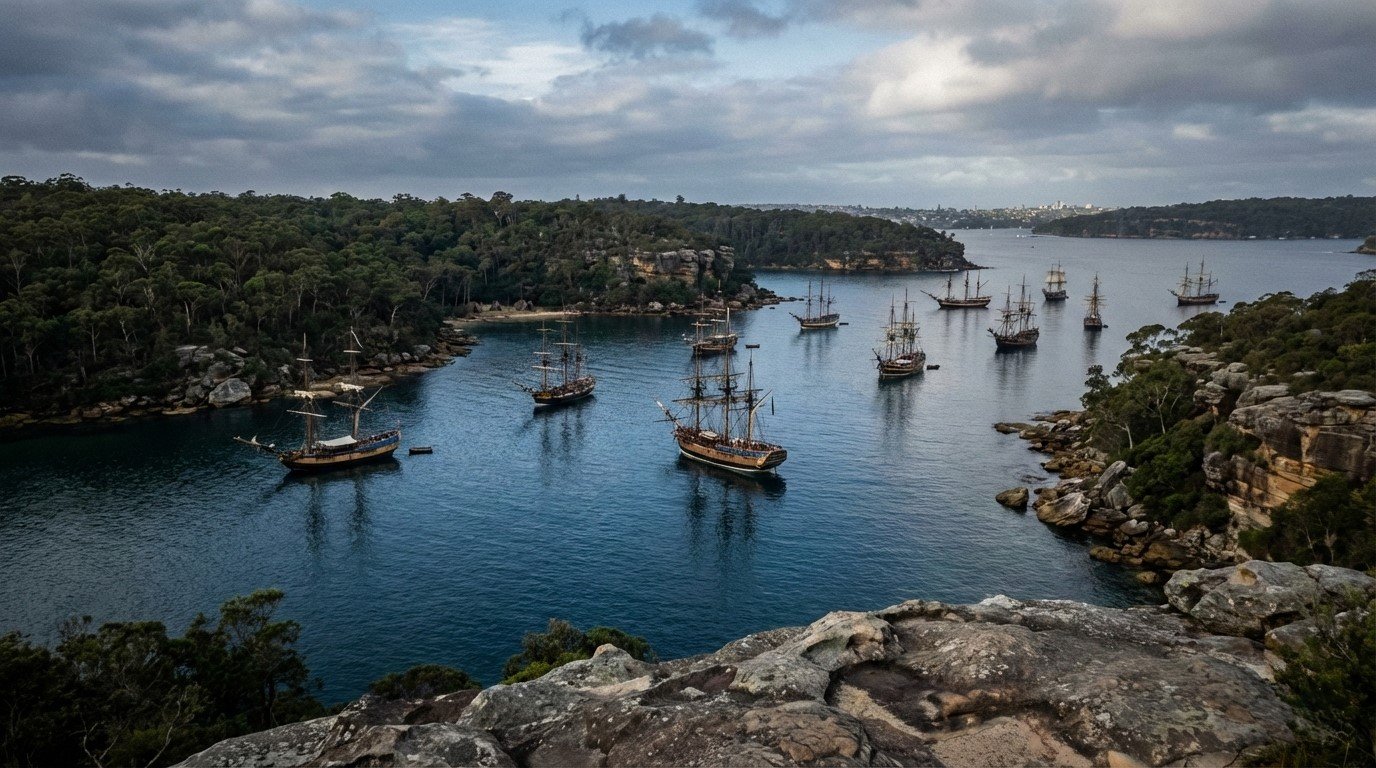
Let's clear the air about something fundamentally wrong with the way many of us were taught Australian history. You've heard the old yarn: England's prisons were bursting at the seams with pickpockets and bread thieves, so they found the furthest, most desolate rock on the map and dumped the "scum" there just to be rid of them.
It's a neat little story. It's also a blatant lie.
If you walk the foreshores of Sydney Harbour today, near where Captain Arthur Phillip actually dropped anchor in January 1788, you aren't standing on the site of a simple prison drop-off. You are standing on the site of the most expensive, high-stakes strategic gamble the British Empire ever undertook.
To understand the ghosts of Sydney's past, you have to understand the reality of their arrival. It wasn't an accident; it was a desperate, incredibly costly plan.
The French Threat and the "Active Improvement" Rule
In 1786, when the orders were given to assemble the First Fleet, Britain wasn't just worried about prison overcrowding; they were terrified of France.
Britain and France had been cycling between cold and hot wars for centuries. France had just announced intentions to seek colonial possessions in the Indian and Pacific oceans. If they established naval bases in New Holland (Australia), they could choke off the vital trade routes of the British East India Company—an economic disaster for the UK.
Britain had to claim the land first. But under international law at the time, you couldn't just plant a flag. The land had to be both militarily occupied, and being "actively improved," which meant under agriculture. Prime Minister William Pitt needed to create an entire agricultural economy from scratch, using reluctant labour, on a strange continent on the far side of the planet, roughly 31 times the size of the UK.
No pressure, right?
The "Space Station" Analogy
The idea that this massive operation was launched just because UK prisons like Belmarsh were a bit full is ludicrous. Governments do not spend that kind of money without a compelling strategic reason.
Consider the cost of an eight-month sea voyage in 1787. Ships were frequently lost to storms or navigation errors; it was an inherently known and feared risk. Statistically, between 1 in 10 and 1 in 5 ships weren't expected to make sea voyage distances that far.
Sending minor offenders to Sydney in 1788 was, in today's terms, the financial equivalent of sending community service offenders to the International Space Station—on incredibly expensive rockets that were known to explode.
You don't do that just to clear out the cells. You do it because you are trying to build an empire.
The Land of the Second Chance
The First Fleet convicts weren't just prisoners kept in chains; they were the mobile labour force required to build the infrastructure that would eventually entice free settlers.
Europeans did the hard yards here, at an enormous cost in effort, blood, and lives. But there was a massive upside for those who survived the ordeal.
In England, the landed gentry was a closed shop left over from feudal times. If you didn't own land—and 85%-90% of men didn't—you couldn't even vote. You were stuck in a permanent poverty cycle.
Australia became the land of the second chance. Convicts who knuckled down and were shown to be of good conduct had their sentences drastically reduced. Upon completion, they were given small land grants, tools, seeds, and a bit of cash to start a farm. By the standards of the time, this was a dramatic, almost unbelievable lift in social status.
Famous Emancipists of Sydney's Lower North Shore
Billy Blue (William Blue): An African-American former convict who became a local celebrity and ferryman. In 1817, Governor Macquarie granted him 80 acres of land at what is now Blue's Point and McMahons Point.
Mary Reibey: Often regarded as one of the most successful business people in colonial NSW. In 1835, she purchased 60 acres (later expanded to 110 acres) on the Lane Cove River in present-day Hunters Hill. She named the property Figtree Farm, which served as her country retreat. She was posthumously honoured on our current Australian $20 note.
John Glade: An emancipist who purchased land in the Kissing Point district in 1817, eventually expanding his holdings through further acquisitions. The suburb of Gladesville is named in his honour.
James Meehan: An Irish emancipist who served as the Deputy Surveyor of Lands. While he held major grants further south (Meehan's Castle), he was instrumental in the surveying and early mapping of land grants across the entire Sydney region, including the North Shore.
Within a single generation, this "dumping ground" was transformed into a booming economy where some of the wealthiest people were "emancipists"—those former convicts who worked their way up through their own considerable efforts.
Why This Matters
Australia became Britain's biggest and most profitable foreign investment by far.
When we look back at the history of the Lower North Shore and Sydney Harbour, it's important we don't dismiss the first arrivals with lazy stereotypes. They were pawns in a massive global chess match, subjected to incredibly dangerous voyages and brutal conditions. But many took that hardest of beginnings and built something incredible.
The real history of Sydney is far more complex, tragic, and impressive than the "dumping ground" myth suggests. And it is in that complex reality that the true stories—and perhaps a few ghosts—can be found.
To truly understand the history beneath your feet, you need to walk the ground where it happened. Join us on the Haunted Sydney Ghost Tour to hear the darker, personal stories of those early days.